
The US Department of Defence has restored the name of the US Indo-Pacific Command to the US Pacific Command, reversing an eight-year-old decision. This change honours the command's deep historical roots, established in 1947, while its vast area of responsibility, extending to India's western border, and its mission remain unchanged.

The Quad grouping has expanded cooperation in critical minerals and energy, while unveiling new measures to boost maritime surveillance and port infrastructure across the Indo-Pacific. This move comes against the backdrop of China's growing military posturing in the region, with ministers reiterating strong opposition to destabilising actions and expressing serious concerns over militarisation of disputed features.

The economic fallout of the West Asia crisis, the prevailing security situation in the Indo-Pacific and ways to boost cooperation in critical minerals and technology are expected to top the agenda at a crucial meeting of the Quad foreign ministers on Tuesday.

A senior US official has emphasised India's crucial role in maintaining peace and stability in the Indo-Pacific region and ensuring a balanced power dynamic in Asia, advocating for stronger defence ties between the two nations.

In the Indo-Pacific's new era -- where perception shapes reality faster than treaties -- the real entrapment is not of China or the United States. It is the test Japan has set for itself -- and whether partners like India, acting as balancers rather than accelerants, can help ensure that the story ends in stability, points out Varun Arya.

Prime Minister Narendra Modi and Indonesian President Prabowo Subianto have significantly advanced the India-Indonesia Comprehensive Strategic Partnership, securing crucial agreements on defence, critical minerals, and maritime security, including BrahMos missile supply and Sabang port development.

Singh emphasised that the Indo-Pacific is no more a maritime construct, but a full-fledged geo-strategic issue, and that the region is facing "a complex web" of security challenges, including boundary disputes and piracy.

The latest announcement was made by the US Defence Secretary Jim Mattis during the change of guard ceremony at Joint Base Pearl Harbour wherein Admiral Phil Davidson replaced Admiral Harry Harris as Commander, US Indo-Pacific Command or IndoPacom.

Although the pact would focus mainly on the Pacific and the South China Sea region, any action designed to deter China with or without New Delhi's active participation is a welcome move, notes Commodore Venugopal Menon (retd).
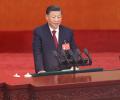
'No Cold War should be reignited and no Ukraine-style crisis should be repeated in Asia'

Prime Minister Narendra Modi concluded his three-nation tour in New Zealand, where he and his counterpart Christopher Luxon elevated bilateral ties to a strategic partnership. The visit focused on doubling trade by 2030 and expanding cooperation in the Indo-Pacific region, marking the first visit by an Indian PM in 40 years.

With over 75 per cent indigenous content, the frigate is among the most self-reliant frontline warships built in India.

India is increasingly a willing participant in the evolving US' Indo-Pacific strategy. While these developments are related to the perception of a growing Chinese security challenge, their implications for India's much-vaunted strategic autonomy should be a matter of deeper and closer reflection, asserts former foreign secretary Shyam Saran.

In their first summit, the leaders of Quad countries on Friday decided to launch a mega vaccine initiative under which coronavirus vaccines will be produced in India for the Indo-Pacific region with financial assistance from the United States and Japan while Australia will contribute in logistical aspects.

This includes over $15 billion of proposed investment in the infrastructure sector in the Indo-Pacific and $9 billion for shoring up American defence in the region.
Prime Minister Narendra Modi's visit to New Zealand culminated in the elevation of bilateral ties to a strategic partnership, with a focus on doubling trade and enhancing cooperation in sports and the Indo-Pacific region. Modi and his counterpart Christopher Luxon attended a sports showcase, acknowledging a century of sporting ties and discussing future collaborations, including India's preparations for the Commonwealth Games 2030. The visit also saw 18 concrete outcomes and 10 agreements signed, alongside discussions with business leaders.

Hangors are effectively 'dead-on-arrival' with Pakistanis saddled with deadweights that displace around 3,000 tons. Last time it was near Vishakhapatnam. This time, barnacles will clog the Hangors in Karachi port itself, points out Dr Abhishek Puri.
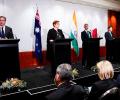
The meeting to be presided over by External Affairs Minister S Jaishankar will be attended by US Secretary of State Antony Blinken, Japanese Foreign Minister Yoshimasa Hayashi and Australia's Penny Wong.

The US "Indo-Pacific Strategy" is bound to be a failed strategy, Wang said in the comments posted by the Chinese foreign ministry on its website.

The Japanese PM's visit to Assam comes amid festering uneasiness in Tokyo about Beijing's assertiveness in the Indo-Pacific region.

The Quad has come of age and its agenda covering areas like vaccines, climate change and emerging technologies makes it a force for global good, Prime Minister Narendra Modi said at the first summit of the coalition. In his opening remarks, he also talked about shared values and promoting a secure, stable and prosperous Indo-Pacific.

Notwithstanding the economic complementarities and the host of agreements for deepening economic relation on a host of areas, both sides share common viewpoints on the foreign policy domain and seek common grounds to serve as a counterweight to China, notes Dr Rajaram Panda.
The foreign ministers of the Quad grouping of India, the US, Australia and Japan on Friday held extensive talks in Melbourne amid escalating tension between Russia and NATO countries over Ukraine, the Afghan crisis and increasing concerns over China's "coercion" in the Indo-Pacific region.

India's historical focus on its continental borders has overshadowed its maritime ambitions, but that is changing quickly, notes Ajai Shukla.

External Affairs Minister S Jaishankar met United States Secretary of State Antony Blinken in Phnom Penh on Sunday and discussed bilateral ties, the raging Ukraine conflict, energy issues, G20 and the situation in the Indo-Pacific, days ahead of a possible meeting between Prime Minister Narendra Modi and President Joe Biden.

External affairs minister S Jaishankar on Tuesday discussed issues relating to Afghanistan and the Indo-Pacific during his bilateral meetings with global counterparts on the sidelines of the annual high-level UN General Assembly session.

The Indian armed forces, especially the Navy, are building partnerships in the Indo-Pacific region for peace and security, as well as humanitarian assistance and disaster relief, he said.

Asserting that "maritime muscle flexing" by some countries and other factors have made the Indo-Pacific region "more contested and more volatile," naval chief Admiral Sunil Lanba on Tuesday said that the Indian Navy has its task cut out as it has been a major security provider in the region.

Japan is deepening its defence relationship with India while simultaneously expanding its economic, infrastructure and security engagement with countries around India -- particularly Bangladesh. The result is an emerging Japanese conception of South Asia in which India remains the strategic anchor, but the geography surrounding India is becoming increasingly important, points out Varun Arya.

Jaishankar also met his Iranian counterpart H Amirabdollahian and held productive discussions on bilateral economic cooperation, Afghanistan and the joint comprehensive plan of action, also known as the Iran nuclear deal.

Juster said as democracies, the US and India are committed to a rules based order as well as to peace and diplomacy.

Prime Minister Narendra Modi and US Secretary of State Marco Rubio discussed various aspects of India-US bilateral ties, focusing on defence, trade, energy, and technology. Rubio extended an invitation from President Donald Trump for PM Modi to visit the US.

In a region increasingly shaped by competition and coercion, such collaboration strengthens security without confrontation, builds capacity without dependency and promotes order without domination, points out Dr Kumar.

Vietnam is an emerging regional power and a closer relationship with Hanoi is closely aligned with Prime Minister Narendra Modi's Act East Policy, points out Dr Rajaram Panda.

President Biden underscored that the United States will 'continue to stand up for its interests and values and, together with our allies and partners, ensure the rules of the road for the 21st century advance an international system that is free, open, and fair', the White House said in a readout of the meeting.

Merlinhawk Aerospace has partnered with Boeing India Defence to provide in-country maintenance, repair, and lifecycle support for advanced Electro-Optical/Infrared (EO/IR) systems on Indian military platforms. This collaboration aims to strengthen local support, reduce turnaround times, and enhance mission readiness for the Indian Navy, aligning with India's self-reliance goals in defence.
Merlinhawk Aerospace has partnered with Boeing India Defence to provide in-country maintenance, repair, and lifecycle support for advanced Electro-Optical/Infrared (EO/IR) systems on Indian military platforms. This collaboration aims to strengthen local support, reduce turnaround times, and enhance mission readiness for the Indian Navy, aligning with India's self-reliance goals in defence.

US Secretary of War Pete Hegseth praised India's military modernisation efforts at the Shangri-La Dialogue in Singapore, highlighting its growing industrial and logistics capacity.

Prime Minister Narendra Modi has called for the resolution of the West Asia crisis and the Ukraine conflict through dialogue and diplomacy, asserting that military action alone cannot achieve lasting peace. He made the remarks after talks with Norwegian Prime Minister Jonas Gahr Store.

The Congressman said the Chinese Communist Party has, unfortunately, botched its response to COVID-19, causing tremendous economic uncertainty and a slowdown in China's economy.
